Reinforce US equity breadth with size and style ETFs
New US equity ETFs give investors precise control over size and style exposures to address concentration risk and strengthen portfolio construction.

New US equity ETFs give investors precise control over size and style exposures to address concentration risk and strengthen portfolio construction.
Concentration in US equity markets has become a defining feature in recent years. The challenge for investors is not whether to hold these dominant companies, but how to complement them by accessing the broader opportunity set across the market.
Exposure to US equities still relies heavily on large-cap benchmarks. While these remain core building blocks, they capture only part of the investable universe, which extends into mid-sized companies and a long tail of smaller firms.
Against this backdrop, the case for more granular exposure – by both size and style – has strengthened. Our new ETFs aim to enable more precise and flexible portfolio construction across the US equity spectrum.
The new ETFs span four distinct exposures – small-cap, mid-cap, growth and value – with each aligned to a specific segment of the Russell index framework:
The US equity market can be broken down into complementary components that behave differently and serve distinct roles in a portfolio. The Russell 2000 Index focuses on smaller companies, offering exposure to stocks that are often more domestically oriented and sensitive to economic cycles.
The Russell Mid Cap Index sits between large- and small-caps, acting as a “completion” exposure that helps reduce reliance on mega-caps. This segment provides a more balanced profile, combining elements of both growth and value while reducing reliance on the largest companies.
Alongside size, the Russell 1000 Growth Index and Russell 1000 Value Index isolate style exposures within the large- and mid-cap universe. Growth focuses on companies with stronger earnings expectations, while value targets firms trading at lower valuations and more cyclical sectors.
Taken together, these four exposures form a coherent set of building blocks. Investors can use them to construct more tailored US equity allocations – whether that means complementing an existing large-cap core exposure by diversifying into smaller companies or expressing a specific style view.
Style exposures provide a distinct dimension of portfolio construction. Growth and value are both drawn from the same large- and mid-cap universe but differ meaningfully in how weight is distributed across industries and companies.
Importantly, these are not simply mirror images. Growth indices tend to be more concentrated, with performance often driven by a relatively small number of industry leaders – particularly within technology and communications. Value indices, by contrast, are typically more diversified across sectors such as financials, energy and industrials.
As the chart below highlights, there are important differences in sector concentration for style versus size exposures. In growth, a small number of dominant industries and companies can account for a significant share of index weight. In contrast, size-based exposures – mid- and small-caps in particular – distribute weight more broadly and more evenly across a wider set of industries and companies.
Consider the Russell 2000 Index. Its largest constituent, HUT 8 Corporation1, has a weighting of just 0.40%, limiting its influence on total market return. By comparison, NVIDIA represents around 14% of the Russell 1000 Growth Index, giving it far greater potential impact on index performance2.
This distinction is critical for portfolio construction. While size exposures expand breadth through a larger number of holdings, style exposures shape how that exposure is concentrated – offering investors different ways to balance diversification and leadership risk.
Sector leadership separates style from size
Cumulative weight by industry (%)
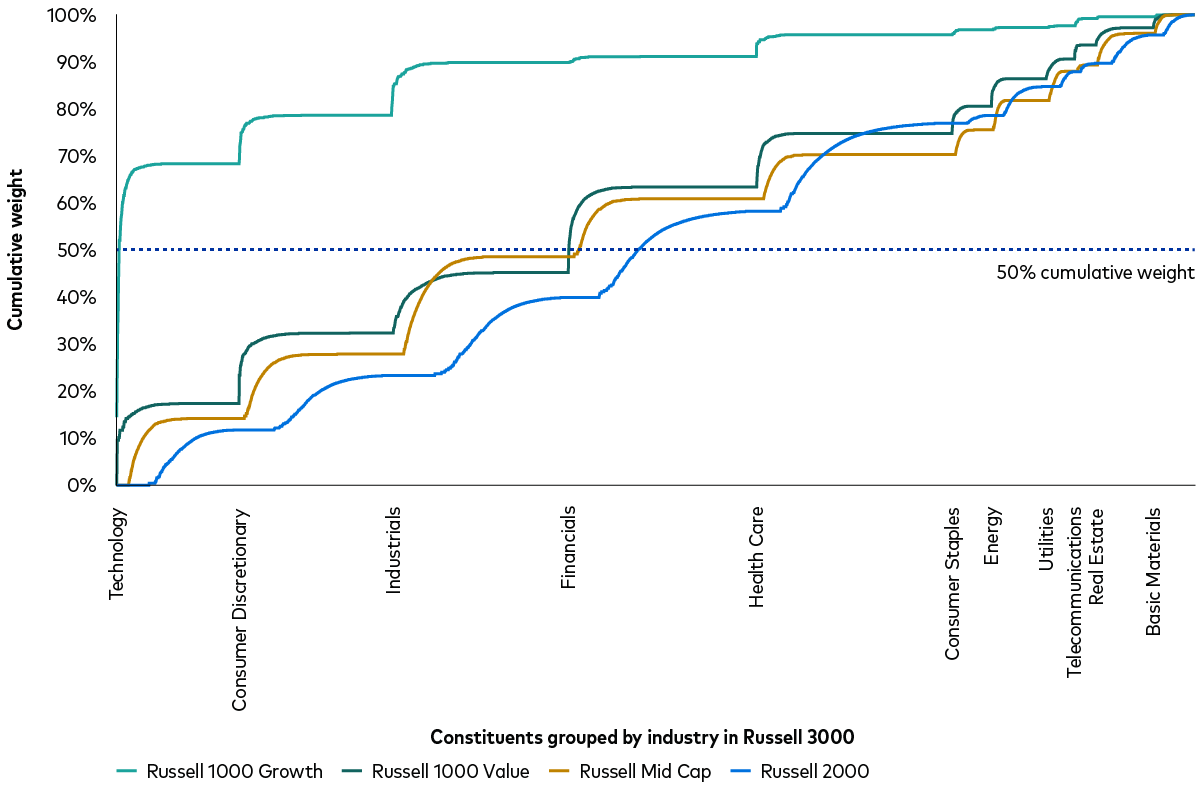
Source: FTSE Russell, Vanguard, based on June 2026 reconstitution files for Russell US indices.
One of the most compelling use cases for combining size and style exposures is managing concentration risk. And rather than viewing these exposures in isolation, their real power lies in combination. A modular approach allows portfolios to be tailored based on objectives.
In growth indices, a small number of mega-cap stocks can account for a significant share of total index weight, meaning performance is heavily influenced by a limited set of companies.
By contrast:
Used together, these building blocks can help portfolio constructors restore breadth to US equity allocations – moving from a concentrated core to a more diversified structure.
Low-cost implementation remains central to the investment case. Our new ETFs are competitively priced, and given the liquidity of US equities, trading costs are typically low – supporting both entry and switching.
This enables investors to refine their US equity exposure without materially increasing costs. As a result, portfolios can move beyond concentrated large-cap allocations towards a more balanced mix across size and style.
The shift towards more targeted exposures reflects a broader evolution in portfolio construction: from broad benchmarks to more precise, modular allocations. In this context, having the right building blocks matters.
1 HUT 8 Corporation is a vertically integrated operator of large-scale energy infrastructure and bitcoin miners.
2 Source: FTSE Russell, Vanguard, weightings are based on the June 2026 reconstitution files for Russell US indices.

Discover tools, guides and multimedia resources. Built for (and with) financial advisers.

Investment risk information
The value of investments, and the income from them, may fall or rise and investors may get back less than they invested.
Investments in smaller companies may be more volatile than investments in well-established blue chip companies.
ETF shares can be bought or sold only through a broker. Investing in ETFs entails stockbroker commission and a bid-offer spread which should be considered fully before investing.
The Funds may use derivatives in order to reduce risk or cost and/or generate extra income or growth. The use of derivatives could increase or reduce exposure to underlying assets and result in greater fluctuations of the Fund's net asset value. A derivative is a financial contract whose value is based on the value of a financial asset (such as a share, bond, or currency) or a market index.
Some funds invest in securities which are denominated in different currencies. Movements in currency exchange rates can affect the return of investments.
For further information on risks please see the “Risk Factors” section of the prospectus on our website.
Important information
This is a marketing communication.
For professional investors only (as defined under the MiFID II Directive) investing for their own account (including management companies (fund of funds) and professional clients investing on behalf of their discretionary clients).
For further information on the fund's investment policies and risks, please refer to the prospectus of the UCITS and to the KIID (for UK, Channel Islands, Isle of Man investors) and to the KID (for European investors) before making any final investment decisions. The KIID and KID for this fund are available in local languages, alongside the prospectus, which is available in English only, via Vanguard’s website.
The information contained herein is not to be regarded as an offer to buy or sell or the solicitation of any offer to buy or sell securities in any jurisdiction where such an offer or solicitation is against the law, or to anyone to whom it is unlawful to make such an offer or solicitation, or if the person making the offer or solicitation is not qualified to do so. The information is general in nature and does not constitute legal, tax, or investment advice. Potential investors are urged to consult their professional advisers on the implications of making an investment in, holding or disposing of shares and /or units of, and the receipt of distribution from any investment.
Vanguard Funds plc has been authorised by the Central Bank of Ireland as a UCITS and has been registered for public distribution in certain EEA countries and the UK. Prospective investors are referred to the Funds' prospectus for further information. Prospective investors are also urged to consult their own professional advisers on the implications of making an investment in, and holding or disposing shares of the Funds and the receipt of distributions with respect to such shares under the law of the countries in which they are liable to taxation.
The Manager of Vanguard Funds plc is Vanguard Group (Ireland) Limited. Vanguard Asset Management, Limited is a distributor for Vanguard Funds plc.
The Manager of the Ireland domiciled funds may determine to terminate any arrangements made for marketing the shares in one or more jurisdictions in accordance with the UCITS Directive, as may be amended from time-to-time.
The Indicative Net Asset Value (“iNAV”) for Vanguard’s ETFs is published on Bloomberg or Reuters. Refer to the Portfolio Holdings Policy.
For investors in Ireland domiciled funds, a summary of investor rights can be obtained via our website and is available in English, German, French, Spanish, Dutch and Italian.
London Stock Exchange Group plc and its group undertakings (collectively, the .LSE Group.). © LSE Group. FTSE Russell is a trading name of certain of the LSE Group companies. e.g., .FTSE®. .Russell®., .FTSE Russell®., .FTSE4Good®., .ICB®., .Mergent®, The Yield Book®,. is/are a trade mark(s) of the relevant LSE Group companies and is/are used by any other LSE Group company under license. All rights in the FTSE Russell indexes or data vest in the relevant LSE Group company which owns the index or the data. Neither LSE Group nor its licensors accept any liability for any errors or omissions in the indexes or data and no party may rely on any indexes or data contained in this communication. No further distribution of data from the LSE Group is permitted without the relevant LSE Group company’s express written consent. The LSE Group does not promote, sponsor or endorse the content of this communication.
For Dutch investors only: The fund(s) referred to herein are listed in the AFM register as defined in section 1:107 Dutch Financial Supervision Act (Wet op het financieel toezicht).For details of the Risk indicator for each fund listed, please see the fact sheet(s) which are available from Vanguard via our website.
Issued in EEA by Vanguard Group (Ireland) Limited which is regulated in Ireland by the Central Bank of Ireland.
Issued by Vanguard Asset Management, Limited which is authorised and regulated in the UK by the Financial Conduct Authority.
© 2026 Vanguard Group (Ireland) Limited. All rights reserved.
© 2026 Vanguard Asset Management, Limited. All rights reserved.