Better ballast: How bond ETFs support portfolios amid geopolitical risk
As geopolitical tensions drive market volatility, hedged global bonds can provide ballast and reduce drawdowns in diversified portfolios.

As geopolitical tensions drive market volatility, hedged global bonds can provide ballast and reduce drawdowns in diversified portfolios.
Volatility has returned as geopolitical tensions rise, compounding existing market concerns about whether ambitious AI-driven revenue projections can be met.
Elevated geopolitical risk often translates into wider dispersion of returns, faster-moving cycles of optimism and caution and a more fragile foundation for asset valuations. In this environment, portfolios can benefit from allocations that help absorb shocks, maintain resilience and provide ballast when uncertainty becomes the dominant market driver. Hedged global bonds have shown characteristics that may help moderate the impact of market volatility as part of a diversified portfolio.
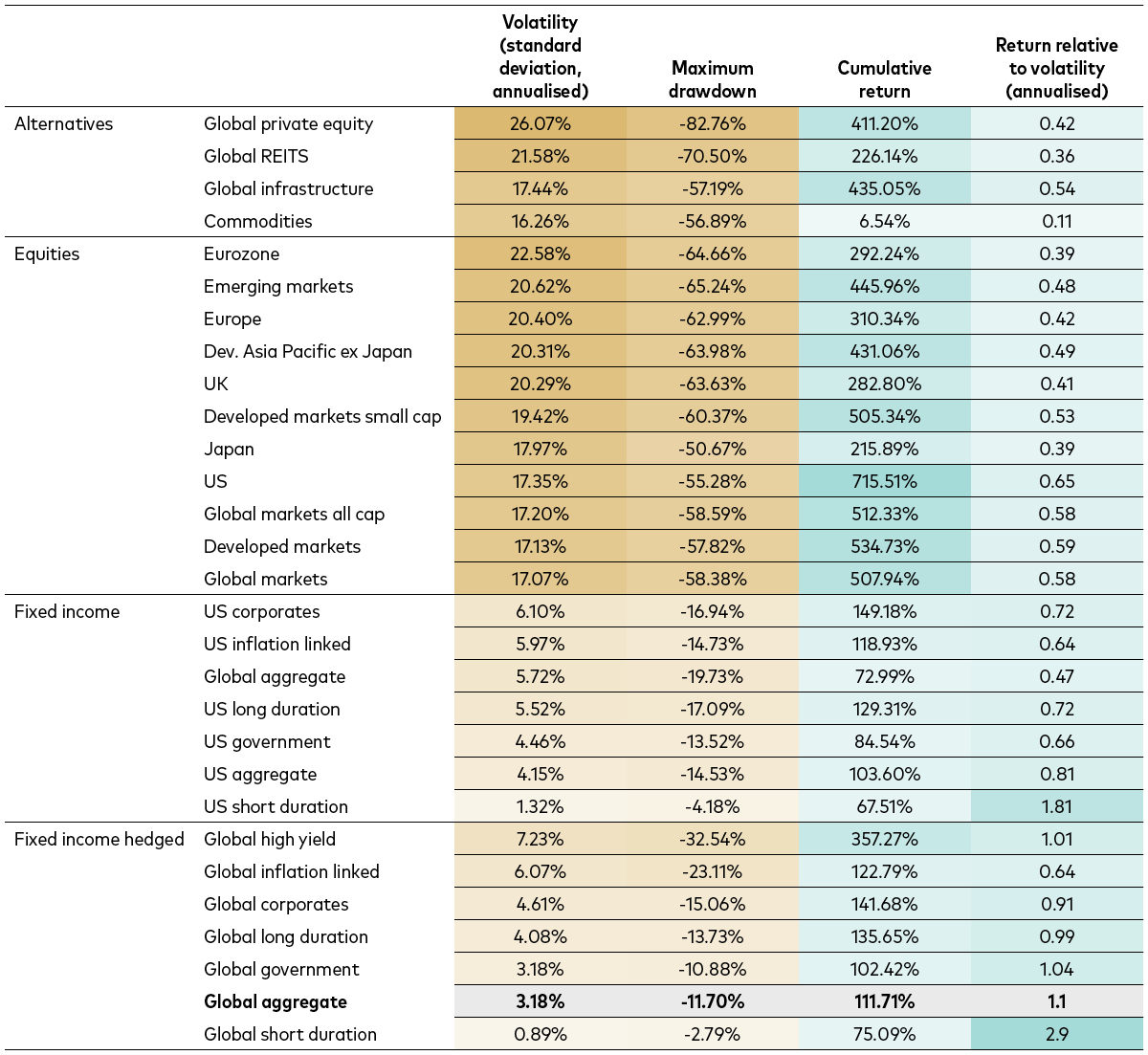
Hedged global bonds, which help to mitigate the impact of currency movements, have shown volatility of roughly 3% per year over a period of more than 20 years, compared with more than 17% for equities (as the table below illustrates). This has translated into far smaller drawdowns: while US and global equities have at times fallen by as much as –55% and –58% over this two-decade time period, hedged global bonds’ maximum decline was –12%.
Historical data indicates (see table below) that hedged global bonds have exhibited lower volatility than certain other major asset classes over the period shown1.
Hedged global bonds: Key components of diversified portfolios
Asset classes ranked by volatility, 31 May 2004 to 31 December 2025
Past performance is not a reliable indicator for future results. The performance of an index is not an exact representation of any particular investment, as you cannot invest directly in an index. Source: Bloomberg, Vanguard. Data is for the period 31 May 2004 to 31 December 2025 and in USD2. Annualisation is based on weekly returns. The Sharpe ratio assumes a zero risk-free return.
For investors seeking ways to mitigate the risk of drawdowns on portfolios, the shock-dampening properties offered by hedged global bonds can be significant. From a risk-adjusted perspective, global hedged bonds have comfortably beaten most other asset classes—except for short-duration bond exposures—during the past 21 years3.
Beyond their role as portfolio anchors, our research points to a supportive outlook for high quality fixed income. Markedly higher yields than in the the pre-pandemic decade underpin our expectation of stronger risk-adjusted returns over the next five to ten years4.
The ETF vehicle, given its cost-efficiency and accessibility, provides investors with an effective building block for adding global bond exposure to portfolios.
A common misconception is that managing index exposures is a ‘set-it-and-forget-it’ exercise.
In reality, managing fixed income index funds and ETFs requires significant expertise. Because replicating every bond in a benchmark is rarely practical or cost effective, portfolio managers use sampling techniques to match index characteristics while keeping costs low. This approach helps maintain tracking accuracy and avoid unnecessary transaction costs that can erode long-term returns.
For index ETFs, the primary objective is to track the performance of a benchmark with as little tracking error as possible.
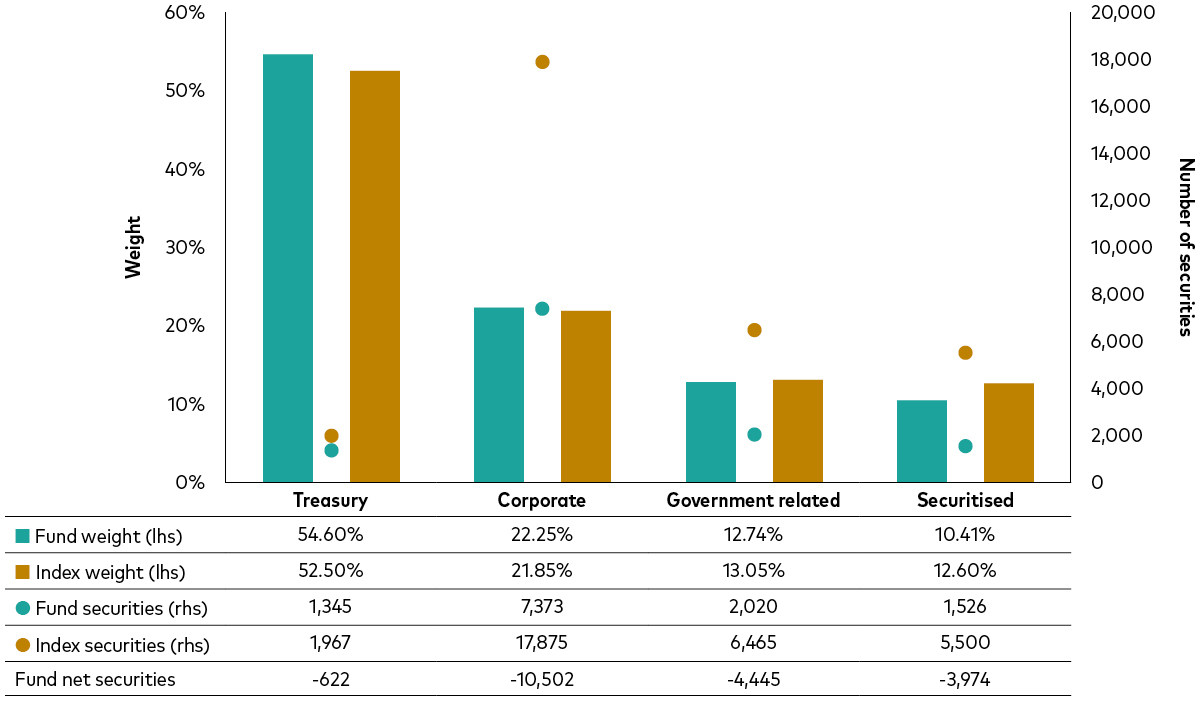
The global bond universe, which comprises tens of thousands of individual fixed income securities, is a case in point. When Vanguard’s portfolio managers aim to replicate the Bloomberg Global Aggregate Float Adjusted and Scaled Index, they hold around one third of the constituents from the 31,000+ total names in the index5. And, although the Vanguard Global Aggregate Bond UCITS ETF holds less than one third of the individual securities, its holdings still comprise almost two-thirds of the universe by market capitalisation.
The chart below shows how sampling techniques allow portfolio managers to closely match index weightings while holding only a portion of the underlying securities. By targeting specific bond issues based on factors such as liquidity, credit quality and maturity, managers can minimise transaction costs while preserving key risk characteristics.
Index sampling: An efficient liquidity management tool
Fund and index weights by category
Source: Bloomberg, as at 31 December 2025. Data are derived from constituents for the Vanguard Global Aggregate Bond UCITS ETF and the Bloomberg Global Aggregate Float Adjusted and Scaled Index. This chart illustrates historical characteristics of the index or fund over the period shown. Historical results should not be relied upon as a guide to future performance.
Even while a fund holds far fewer bonds than the index, its portfolio managers can closely match the benchmark’s essential risk characteristics such as duration, credit risk and yield as they seek to mirror the index’s performance. In the case of managing a global aggregate bond ETF, our managers have historically kept tracking error consistently tight across market cycles and environments – for further information, please visit our fund pages6.
For investors who would like to explore the topic further, our ETF resources page has information on our ETF offering and fixed income exposures more specifically. And in our fixed income outlook, we consider how high real yields support the case for bonds in 2026 – although quality is key as AI-driven risks rise and tight valuations leave little room for error.
1 These observations relate to the specific timeframe and should not be interpreted as indicative of future outcomes.
2 Benchmarks and indices used: US equities = S&P 500 Net Total Return Index, UK equities = FTSE All Share Net Total Return Index, developed market equities = MSCI World Net Total Return Index, global markets all cap equities = MSCI ACWI IMI Net Total Return Index, Europe equities = MSCI Europe Net Total Return Index, eurozone equities = MSCI EMU Net Total Return Index, developed Asia Pacific ex Japan equities = MSCI Pacific ex Japan Net Total Return Index, Japan equities = MSCI Japan Net Total Return Index, emerging market equities = MSCI Emerging Net Total Return Index, global market equities = MSCI ACWI Net Total Return Index, developed market small-cap equities = MSCI World Small Cap Net Total Return Index, global aggregate fixed income = Bloomberg Global-Aggregate Total Return Index Unhedged USD, US aggregate fixed income = Bloomberg US Aggregate Total Return Index Unhedged USD, US short-duration fixed income = Bloomberg US Aggregate 1-3 Year Total Return Index Unhedged USD, US long-duration fixed income = Bloomberg US Aggregate 7-10 Year Total Return Index Unhedged USD, US government fixed income = Bloomberg US Treasury Total Return Unhedged USD, US inflation-linked fixed income = Bloomberg US Government Inflation-Linked All Maturities Total Return Index Unhedged USD, US corporates fixed income = Bloomberg US Corporate Total Return Index Unhedged USD, global short-duration fixed income hedged = Bloomberg Global Aggregate 1-3 Year Total Return Index Hedged USD, global long duration fixed income hedged = Bloomberg Global Aggregate 7-10 Year Total Return Index Hedged USD, global government fixed income hedged = Bloomberg Global Aggregate Treasuries Total Return Index Hedged USD, global inflation-linked fixed income hedged = Bloomberg Global Inflation-Linked Total Return Index Hedged USD, global corporates fixed income hedged = Bloomberg Global Aggregate Corporate Total Return Index Hedged USD, global high yield fixed income hedged = Bloomberg Global High Yield Total Return Index Hedged USD, global aggregate fixed income hedged = Bloomberg Global Aggregate Total Return Index Hedged USD, commodity alternatives = Bloomberg Commodity Index Total Return, global REITS alternatives = S&P Global REIT Net Total Return Index, global infrastructure alternatives = S&P Global Infrastructure Net Total Return Index, global private equity alternatives = S&P Listed Private Equity Net Total Return Index.
3 Sharpe ratio is a measure of risk-adjusted return. To calculate a Sharpe ratio, an asset’s excess return (its return in excess of the return generated by risk-free assets such as Treasury bills) is divided by the asset’s standard deviation.
4 Future market conditions are uncertain, and the behaviour of fixed income markets will depend on a range of economic and geopolitical factors. The information provided reflects research conclusions based on current data at the time of publication and does not constitute a forecast.
5 As at 31 January 2026, the index comprised 31,683 securities.
6 The fund’s objective is to track its benchmark as closely as reasonably possible; actual tracking differences will vary depending on market conditions and operational factors.

Discover tools, guides and multimedia resources covering topics from investment principles to portfolio construction.

Investment risk information
The value of investments, and the income from them, may fall or rise and investors may get back less than they invested.
Past performance is not a reliable indicator of future results. The performance data does not take account of the commissions and costs incurred in the issue and redemption of shares.
Performance figures shown may be calculated in a currency that differs from the currency of the share class that you are invested in. As a result, returns may decrease or increase due to currency fluctuations.
Some funds invest in emerging markets which can be more volatile than more established markets. As a result the value of your investment may rise or fall.
Investments in smaller companies may be more volatile than investments in well-established blue chip companies.
ETF shares can be bought or sold only through a broker. Investing in ETFs entails stockbroker commission and a bid-offer spread which should be considered fully before investing.
Funds investing in fixed interest securities carry the risk of default on repayment and erosion of the capital value of your investment and the level of income may fluctuate. Movements in interest rates are likely to affect the capital value of fixed interest securities. Corporate bonds may provide higher yields but as such may carry greater credit risk increasing the risk of default on repayment and erosion of the capital value of your investment. The level of income may fluctuate and movements in interest rates are likely to affect the capital value of bonds.
The Funds may use derivatives in order to reduce risk or cost and/or generate extra income or growth. The use of derivatives could increase or reduce exposure to underlying assets and result in greater fluctuations of the Fund's net asset value. A derivative is a financial contract whose value is based on the value of a financial asset (such as a share, bond, or currency) or a market index.
For further information on risks please see the “Risk Factors” section of the prospectus on our website.
Important information
This is a marketing communication.
For professional investors only (as defined under the MiFID II Directive) investing for their own account (including management companies (fund of funds) and professional clients investing on behalf of their discretionary clients). In Switzerland for professional investors only. Not to be distributed to the public.
The information contained herein is not to be regarded as an offer to buy or sell or the solicitation of any offer to buy or sell securities in any jurisdiction where such an offer or solicitation is against the law, or to anyone to whom it is unlawful to make such an offer or solicitation, or if the person making the offer or solicitation is not qualified to do so. The information is general in nature and does not constitute legal, tax, or investment advice. Potential investors are urged to consult their professional advisers on the implications of making an investment in, holding or disposing of "units/shares", and the receipt of distribution from any investment.
For Swiss professional investors: Potential investors will not benefit from the protection of the FinSA on assessing appropriateness and suitability.
Vanguard Funds plc has been authorised by the Central Bank of Ireland as a UCITS and has been registered for public distribution in certain EEA countries and the UK. Prospective investors are referred to the Funds' prospectus for further information. Prospective investors are also urged to consult their own professional advisers on the implications of making an investment in, and holding or disposing shares of the Funds and the receipt of distributions with respect to such shares under the law of the countries in which they are liable to taxation.
The Manager of Vanguard Funds plc is Vanguard Group (Ireland) Limited. Vanguard Asset Management, Limited is a distributor for Vanguard Funds plc.
For Swiss professional investors: The Manager of Vanguard Funds plc is Vanguard Group (Ireland) Limited. Vanguard Investments Switzerland GmbH is a financial services provider, providing services in the form of purchase and sales according to Art. 3 (c)(1) FinSA . Vanguard Investments Switzerland GmbH will not perform any appropriateness or suitability assessment. Furthermore, Vanguard Investments Switzerland GmbH does not provide any services in the form of advice. Vanguard Funds plc has been authorised by the Central Bank of Ireland as a UCITS. Prospective investors are referred to the Funds' prospectus for further information. Prospective investors are also urged to consult their own professional advisors on the implications of making an investment in, and holding or disposing shares of the Funds and the receipt of distributions with respect to such shares under the law of the countries in which they are liable to taxation.
For Swiss professional investors: Vanguard Funds plc has been approved for offer in Switzerland by the Swiss Financial Market Supervisory Authority. The information provided herein does not constitute an offer of Vanguard Funds plc in Switzerland pursuant to FinSA and its implementing ordinance. This is solely an advertisement pursuant to FinSA and its implementing ordinance for Vanguard Funds plc. The Representative and the Paying Agent in Switzerland is BNP Paribas Securities Services, Paris, succursale de Zurich, Selnaustrasse 16, 8002 Zurich. Copies of the Articles of Incorporation, KID, Prospectus, Declaration of Trust, By-Laws, Annual Report and Semiannual Report for these funds can be obtained free of charge from the Swiss Representative or from Vanguard Investments Switzerland GmbH via our website.
The Manager of the Ireland domiciled funds may determine to terminate any arrangements made for marketing the shares in one or more jurisdictions in accordance with the UCITS Directive, as may be amended from time-to-time.
The Indicative Net Asset Value (“iNAV”) for Vanguard’s ETFs is published on Bloomberg or Reuters. Refer to the Portfolio Holdings Policy.
For investors in Ireland domiciled funds, a summary of investor rights can be obtained which is available in English, German, French, Spanish, Dutch and Italian.
BLOOMBERG® is a trademark and service mark of Bloomberg Finance L.P. Bloomberg Finance L.P. and its affiliates, including Bloomberg Index Services Limited ("BISL") (collectively, "Bloomberg"), or Bloomberg's licensors own all proprietary rights in the Bloomberg Indices.
The products are not sponsored, endorsed, issued, sold or promoted by “Bloomberg.” Bloomberg makes no representation or warranty, express or implied, to the owners or purchasers of the products or any member of the public regarding the advisability of investing in securities generally or in the products particularly or the ability of the Bloomberg Indices to track general bond market performance. Bloomberg shall not pass on the legality or suitability of the products with respect to any person or entity. Bloomberg’s only relationship to Vanguard and the products are the licensing of the Bloomberg Indices which are determined, composed and calculated by BISL without regard to Vanguard or the products or any owners or purchasers of the products. Bloomberg has no obligation to take the needs of the products or the owners of the products into consideration in determining, composing or calculating the Bloomberg Indices. Bloomberg shall not be responsible for and has not participated in the determination of the timing of, prices at, or quantities of the products to be issued. Bloomberg shall not have any obligation or liability in connection with the administration, marketing or trading of the products.
For Dutch investors only: The fund(s) referred to herein are listed in the AFM register as defined in section 1:107 Dutch Financial Supervision Act (Wet op het financieel toezicht).For details of the Risk indicator for each fund listed, please see the fact sheet(s) which are available from Vanguard via our website.
Issued in EEA by Vanguard Group (Ireland) Limited which is regulated in Ireland by the Central Bank of Ireland.
Issued in Switzerland by Vanguard Investments Switzerland GmbH.
Issued by Vanguard Asset Management, Limited which is authorised and regulated in the UK by the Financial Conduct Authority.
© 2026 Vanguard Group (Ireland) Limited. All rights reserved.
© 2026 Vanguard Investments Switzerland GmbH. All rights reserved.
© 2026 Vanguard Asset Management, Limited. All rights reserved.