Fixed income outlook: Key themes for investors in 2026
High real yields support the case for bonds in 2026, but quality is key as AI-driven risks rise and tight valuations leave little room for error.

High real yields support the case for bonds in 2026, but quality is key as AI-driven risks rise and tight valuations leave little room for error.
Set against a higher neutral rate backdrop, bonds offer a compelling mix of strong yields and diversification.
In 2025, government and corporate bond markets in the US, UK and euro area delivered solid returns1, thanks to strong starting yields and tightening credit spreads. Looking ahead, we think bonds will continue to deliver compelling real returns, exceeding the expected rate of future inflation, no matter what central banks do in 2026.
Within fixed income, we stress the importance of quality. Credit spreads have compressed to historically tight levels, and are now approaching the record lows last seen during the technology boom of the 1990s.
While supply/demand mismatches could keep credit spreads compressed, the prospect of further tightening is low. This presents a one-sided risk profile - to the downside, since current valuations offer little room for error and limited compensation for risks associated with the AI investment cycle.2
Record-low credit spreads leave limited room for further tightening
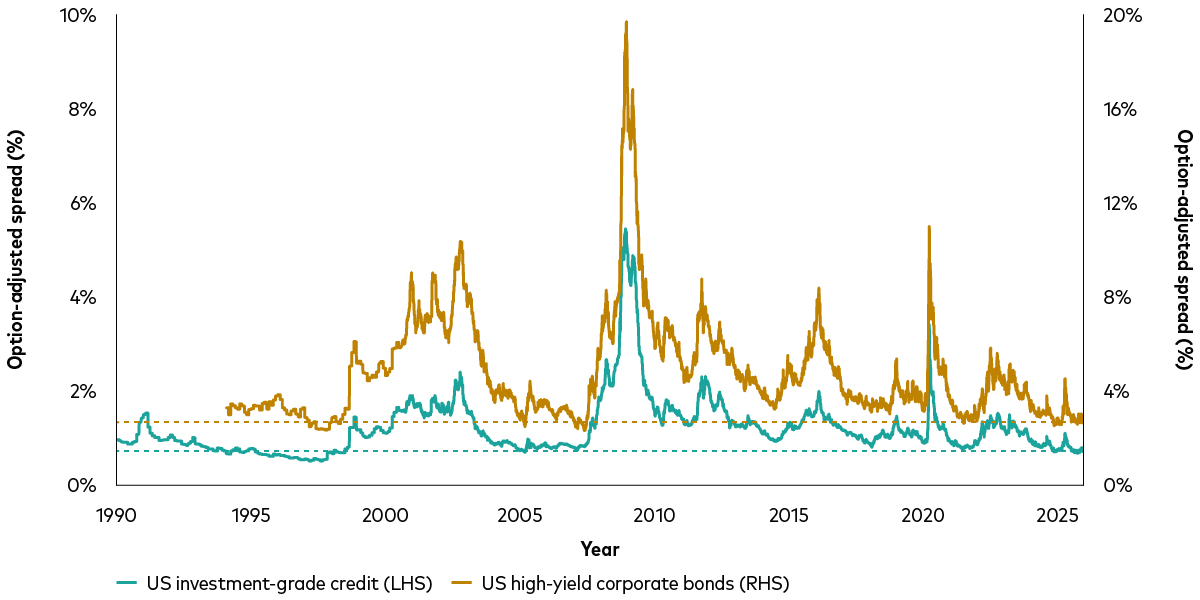
Notes: The chart shows the option adjusted spreads (OAS) for the Bloomberg US Credit Index (green line) and the Bloomberg US High Yield Corporate Bond index (brown line). The dashed lines indicate recent spread values for each index, as at 2 January 2026.
Source: Vanguard and Refinitiv, as at 2 January 2026.
A strong economic environment will likely keep credit spreads tight - both in the US, where we expect growth to accelerate above 2%, and in Europe, where growth is expected to be closer to long-term trends.
As the AI investment cycle continues, bond markets will need to absorb an increasing amount of debt issuance, which could put pressure on spreads to widen. At the same time, current credit valuations offer limited additional compensation over government bonds for the risks associated with this infrastructure buildout. As capital-intensive AI projects proliferate, the potential for credit stress, especially among lower-rated issuers, rises. As a result of these dynamics, we expect global bonds to deliver strong returns in the range of 3.6%-5.1%3 over the next 10 years.
High-quality bonds offer compelling returns for the risk
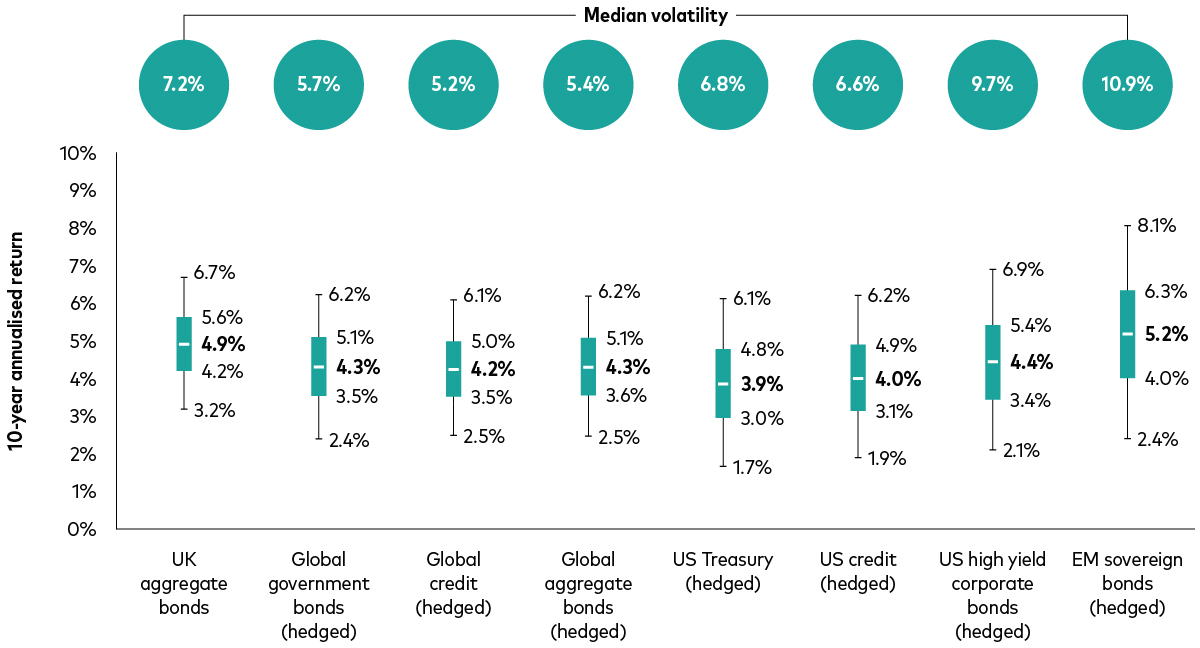
Notes: Forecasts based on the distribution of 10,000 VCMM simulations for 10-year annualised nominal returns in GBP for the highlighted asset classes. Asset class returns do not take into account management fees, expenses or the effect of taxes. Returns do reflect the reinvestment of income and capital gains. Indices act as proxies for the highlighted asset classes and are unmanaged; therefore, investing directly in the indices is not possible.
Source: Vanguard calculations, as at 31 October 2025.
With credit spreads so tight, we expect broad investment-grade corporate bonds to provide limited excess returns over government bonds with a similar duration profile. Over the next 10 years, we expect US corporate bonds (GBP hedged) to produce annualised returns of 4.0%4, compared with 3.9% for US Treasuries (GBP hedged), both with a duration of around six to seven years.
With returns in this range, the case for bonds in investor portfolios remains strong. While we remain constructive on value-oriented US equities and developed-market ex-US equities, we maintain our view that high-quality bonds can improve a portfolio’s risk profile and provide diversification against the material downside risk that an AI-driven productivity boost is not realised or even leads to a pullback in equity markets in 2026 or beyond.
See Vanguard’s range of fixed income funds, ETFs and model portfolios here.
1 Returns for US, UK and European government and corporate bonds hedged to GBP for the period from 31 December 2024 to 31 December 2025 were: US government: 6.2%; US corporate: 7.7%; UK government: 5%; UK corporate: 6.8%; European government: 5.1%; European corporate: 5.1%. Proxies used: Bloomberg US Treasury GBP Hedged; Bloomberg US Credit GBP Hedged; Bloomberg GBP Gilts; Bloomberg GBP Non-Gilts; Bloomberg Euro-Aggregate Treasury GBP Hedged; Bloomberg Euro-Aggregate Corporates GBP Hedged. Source: Refinitiv.
2 As capital-intensive AI projects proliferate, the potential for credit stress rises, especially among lower-rated issuers.
3 Based on Vanguard’s Vanguard’s 10-year annualised return forecast for global aggregate bonds (GBP hedged), as at 31 October 2025.
4 Based on Vanguard’s 10-year annualised return forecast for US corporate bonds (GBP hedged), as at 31 October 2025.
Discover tools, guides and multimedia resources. Built for (and with) financial advisers.
Explore upcoming events and our on-demand library. All CPD accredited.
IMPORTANT: The projections or other information generated by the Vanguard Capital Markets Model® regarding the likelihood of various investment outcomes are hypothetical in nature, do not reflect actual investment results, and are not guarantees of future results. VCMM results will vary with each use and over time. The VCMM projections are based on a statistical analysis of historical data. Future returns may behave differently from the historical patterns captured in the VCMM. More important, the VCMM may be underestimating extreme negative scenarios unobserved in the historical period on which the model estimation is based.
The Vanguard Capital Markets Model® is a proprietary financial simulation tool developed and maintained by Vanguard’s primary investment research and advice teams. The model forecasts distributions of future returns for a wide array of broad asset classes. Those asset classes include US and international equity markets, several maturities of the US Treasury and corporate fixed income markets, international fixed income markets, US money markets, commodities, and certain alternative investment strategies. The theoretical and empirical foundation for the Vanguard Capital Markets Model is that the returns of various asset classes reflect the compensation investors require for bearing different types of systematic risk (beta). At the core of the model are estimates of the dynamic statistical relationship between risk factors and asset returns, obtained from statistical analysis based on available monthly financial and economic data from as early as 1960. Using a system of estimated equations, the model then applies a Monte Carlo simulation method to project the estimated interrelationships among risk factors and asset classes as well as uncertainty and randomness over time. The model generates a large set of simulated outcomes for each asset class over several time horizons. Forecasts are obtained by computing measures of central tendency in these simulations. Results produced by the tool will vary with each use and over time.
The primary value of the VCMM is in its application to analysing potential client portfolios. VCMM asset-class forecasts—comprising distributions of expected returns, volatilities, and correlations—are key to the evaluation of potential downside risks, various risk–return trade-offs, and the diversification benefits of various asset classes. Although central tendencies are generated in any return distribution, Vanguard stresses that focusing on the full range of potential outcomes for the assets considered, such as the data presented in this paper, is the most effective way to use VCMM output.
The VCMM seeks to represent the uncertainty in the forecast by generating a wide range of potential outcomes. It is important to recognise that the VCMM does not impose “normality” on the return distributions, but rather is influenced by the so-called fat tails and skewness in the empirical distribution of modelled asset-class returns. Within the range of outcomes, individual experiences can be quite different, underscoring the varied nature of potential future paths. Indeed, this is a key reason why we approach asset-return outlooks in a distributional framework.
Investment risk information
The value of investments, and the income from them, may fall or rise and investors may get back less than they invested.
Past performance is not a reliable indicator of future results. The performance data does not take account of the commissions and costs incurred in the issue and redemption of shares.
Any projections should be regarded as hypothetical in nature and do not reflect or guarantee future results.
Important information
For professional investors only (as defined under the MiFID II Directive) investing for their own account (including management companies (fund of funds) and professional clients investing on behalf of their discretionary clients). In Switzerland for professional investors only. Not to be distributed to the public.
The information contained herein is not to be regarded as an offer to buy or sell or the solicitation of any offer to buy or sell securities in any jurisdiction where such an offer or solicitation is against the law, or to anyone to whom it is unlawful to make such an offer or solicitation, or if the person making the offer or solicitation is not qualified to do so. The information does not constitute legal, tax, or investment advice. You must not, therefore, rely on it when making any investment decisions.
The information contained herein is for educational purposes only and is not a recommendation or solicitation to buy or sell investments.
Issued in EEA by Vanguard Group (Ireland) Limited which is regulated in Ireland by the Central Bank of Ireland.
Issued in Switzerland by Vanguard Investments Switzerland GmbH.
Issued by Vanguard Asset Management Limited which is authorised and regulated in the UK by the Financial Conduct Authority.
© 2026 Vanguard Group (Ireland) Limited. All rights reserved.
© 2026 Vanguard Investments Switzerland GmbH. All rights reserved.
© 2026 Vanguard Asset Management, Limited. All rights reserved.