Why float matters in global bond beta: Lessons from Japan
Float-adjusted global bond indices aim to reflect what investors can actually own – Japan offers a powerful real-world test of why that matters.

Float-adjusted global bond indices aim to reflect what investors can actually own – Japan offers a powerful real-world test of why that matters.
For portfolio constructors assessing fixed income allocations, global bonds have re‑entered the conversation with renewed credibility. The return of positive real yields has restored the asset class’s income potential, while diversification across issuers and regions remains a core portfolio objective. But as global bond beta regains relevance, how that exposure is constructed matters as much as why it is held.
Market‑capitalisation‑weighted indices remain the most common starting point. Yet in fixed income, market size does not always equate to accessibility. Central bank ownership, regulatory constraints and policy intervention can materially distort the portion of a bond market that is actually available to investors. Float‑adjusted indices attempt to address this by reducing the weight of securities that are effectively removed from the market, aiming to reflect the investible opportunity set more accurately.
Japan provides a timely and revealing example of why that distinction matters.
Japan is one of the world’s largest bond markets, accounting for roughly 8-9% of traditional global aggregate indices1. For decades, that weight appeared uncontroversial. But the Bank of Japan’s (BoJ’s) prolonged monetary intervention has fundamentally changed the structure of the Japanese government bond (JGB) market.
After years of quantitative easing and yield curve control, the BoJ owns approximately 43% of outstanding JGBs, dramatically reducing secondary‑market liquidity2. At the same time, the central bank’s policy shift since 2024—including rate hikes, reduced asset purchases and the abandonment of explicit yield targets—has exposed a difficult trade‑off: allow yields to rise further, increasing government financing costs, or lean back towards accommodation and risk renewed currency weakness.
That dilemma is not theoretical. By the end of 2025, long‑dated JGB yields had climbed to levels not seen in decades, even as the yen remained under pressure (see chart below). With gross government debt near 230% of GDP and Japan heavily reliant on imported energy and food, inflation sensitivity to currency weakness remains high3. For investors, this creates a market where policy risk, duration risk and political risk increasingly overlap.
Conflicting pressures facing the Bank of Japan
Long-term yields rising despite currency weakness
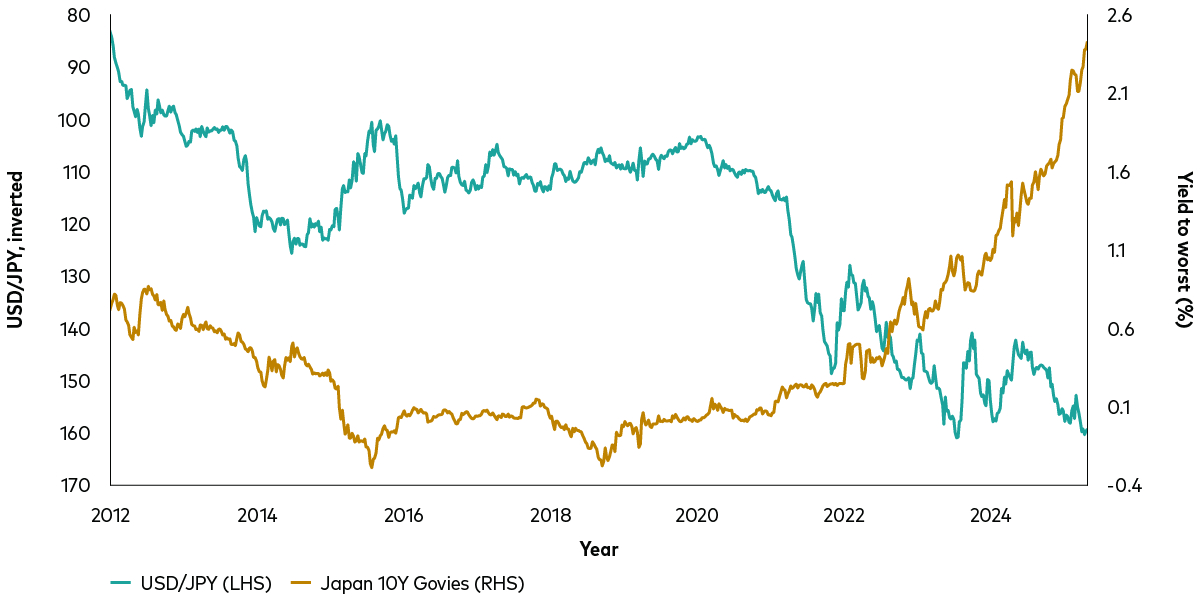
Past performance is not a reliable indicator of future performance. Historical data shown are for illustrative purposes only and do not constitute a forecast.
Source: Bloomberg. Data are from 16 December 2012 (when Shinzo Abe’s Liberal Democratic Party won th general election) to 10 April 2026. Indices used: Japan 10-year government bonds = Generic Japan 10-year government bond; USD/JPY = USDJPY spot exchange rate.
Traditional bond indices treat Japan’s bond market as fully investible, regardless of how much of it is essentially locked away on the BoJ’s balance sheet. Float‑adjusted indices offer an alternative perspective: By excluding bonds that are effectively unavailable to investors, they reduce Japan’s weight meaningfully – while reallocating towards markets where yields are set more clearly by fundamentals.
The result is not a tactical call on Japan, but a structural one.
Importantly, this tilt has historically supported income generation. Higher average coupons, reinvested at higher yields, compound over time – and for bonds, income remains the dominant driver of long‑term total returns.
Japan’s experience highlights a broader point: in fixed income, scale alone is a poor proxy for opportunity. Markets shaped by extraordinary policy support can look stable for long periods, only to become sources of volatility should that support be questioned or withdrawn.
For investors using global bond beta as a core exposure, float‑adjusted index methodologies are designed to recognise that reality. By anchoring allocations to accessibility rather than issuance alone, they aim to reduce unintended concentrations and better align exposure with investible risk.
As global bond markets adjust to a post‑QE world, Japan stands out not as an outlier but as a stress test. And it is precisely in these stress tests that index design shows its value.
Beyond float-adjusting, scaling global bond indices as an additional step can help reduce structural concentration in fixed income exposure. To learn more about what a float-adjusted and scaled global bond index exposure can bring to your portfolio, read our deep dive, Global bond beta unpacked: Investment case, index selection and implementation.
1 Source: Bloomberg, as at 31 March 2026 the total weight was 8.2%.
2 Source: CEIC Data, as at December 2025.
3 Source: International Monetary Fund, data projection for 2026 as at October 2025.
Discover tools, guides and multimedia resources. Built for (and with) financial advisers.
Explore upcoming events and our on-demand library. All CPD accredited.
Investment risk information
The value of investments, and the income from them, may fall or rise and investors may get back less than they invested.
Funds investing in fixed interest securities carry the risk of default on repayment and erosion of the capital value of your investment and the level of income may fluctuate. Movements in interest rates are likely to affect the capital value of fixed interest securities. Corporate bonds may provide higher yields but as such may carry greater credit risk increasing the risk of default on repayment and erosion of the capital value of your investment. The level of income may fluctuate and movements in interest rates are likely to affect the capital value of bonds.
Important information
This is a marketing communication.
For professional investors only (as defined under the MiFID II Directive) investing for their own account (including management companies (fund of funds) and professional clients investing on behalf of their discretionary clients). In Switzerland for professional investors only. Not to be distributed to the public.
The information contained herein is not to be regarded as an offer to buy or sell or the solicitation of any offer to buy or sell securities in any jurisdiction where such an offer or solicitation is against the law, or to anyone to whom it is unlawful to make such an offer or solicitation, or if the person making the offer or solicitation is not qualified to do so. The information does not constitute legal, tax, or investment advice. You must not, therefore, rely on it when making any investment decisions.
The information contained herein is for educational purposes only and is not a recommendation or solicitation to buy or sell investments.
Issued in EEA by Vanguard Group (Ireland) Limited which is regulated in Ireland by the Central Bank of Ireland.
Issued in Switzerland by Vanguard Investments Switzerland GmbH.
Issued by Vanguard Asset Management, Limited which is authorised and regulated in the UK by the Financial Conduct Authority.
© 2026 Vanguard Group (Ireland) Limited. All rights reserved.
© 2026 Vanguard Investments Switzerland GmbH. All rights reserved.
© 2026 Vanguard Asset Management, Limited. All rights reserved.