- The US dollar has weakened, prompting concerns around inflation and pressure on US government bonds, but it remains strong by historical standards, reflecting an adjustment, not a crisis.
- Structural forces, including shifts in the global economic order, US policy volatility and the size of the US current account deficit, are driving a gradual move away from the dollar and into other currencies.
- In this environment, we are seeing relative‑value opportunities emerge in non‑US sovereign debt, term premiums and select credit sectors of the global fixed income market.
The US dollar has weakened in recent months and media coverage has raised the spectre of a “debasement trade”, fuelling fears of higher US inflation and pressure on US government bond markets.
We believe the US dollar is on a gradual weakening trend, but this is not a US dollar crisis. However, the counter-cyclical properties that the dollar has offered historically may be less assured in the future.
The dollar remains historically strong and structurally dominant despite recent weakness. The ICE U.S. Dollar index (which measures the value of the US dollar against a basket of other currencies) is heavily weighted to the euro, which can overstate dollar moves when the euro experiences sharp swings.
Broader trade‑weighted measures suggest a more balanced picture. While the dollar is modestly lower over the past year, it remains higher over the last five years and broadly stronger than its long‑term average. In our view, the dollar is still slightly overvalued and adjusting from elevated levels, rather than entering a period of sustained decline.
We expect the US dollar to continue to drift lower over time, reflecting valuation and realignment of the global economic order rather than a structural breakdown reflecting any fundamental loss of confidence in the currency.
Trade-weighted index tells the real story of the US dollar
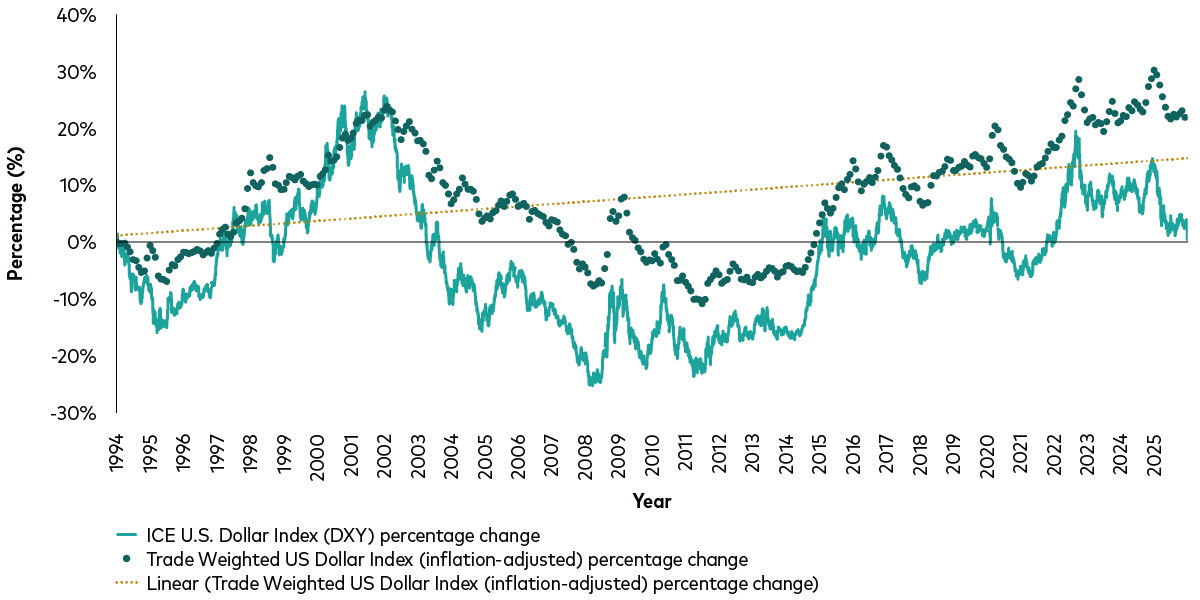
Past performance is no guarantee of future returns. The performance of an index is not an exact representation of any particular investment, as you cannot invest directly in an index.
Source: Ycharts, data as at 30 January 2026.
What’s behind the recent moves?
Europe’s push for greater political and economic independence from the US, combined with volatility in US policymaking, has increased the incentive for governments and investors to diversify away from US dollar exposure into other currencies. One of the dollar’s most apparent vulnerabilities is the size of the US current account deficit. Sustaining dollar strength requires sizable capital account inflows, and a recent softening in those inflows has contributed to the dollar’s downward drift.
Global ex-US investors have also typically owned US assets with low currency hedge ratios because the US dollar has tended to appreciate during times of stress, providing a degree of portfolio diversification. However, the decline in the US dollar alongside US assets in the aftermath of last April’s tariff announcements has led some investors to reassess this assumption, and there is evidence that investors are increasing their currency hedge ratios on US assets.
Emerging investment opportunities in fixed income
As investors seek greater diversification amid widening deficits, valuation impacts are beginning to emerge in fixed income markets. While a weaker dollar may provide near-term support for US economic growth, it also raises the risk of imported inflation. That dynamic could limit the US Federal Reserve’s (Fed’s) ability to ease policy and contribute to increased volatility in the US Treasury market.
Active fixed income managers who are nimble and focused on relative value are well positioned to capitalise on these conditions. Opportunities are especially compelling in non-US sovereign debt where currency appreciation may lead other major central banks around the world, such as the European Central Bank, Bank of Japan or Bank of England, to adopt more accommodative policy stances.
What it means for bond portfolios
While equity markets may get attention, we believe that global fixed income will become increasingly dynamic.
• Global bond opportunities offer diversification:
Our active fixed income team has been diversifying into non-US sovereign debt and credit to take advantage of changing global interest-rate dynamics. We try to capitalise on relative value between US Treasuries and developed market government bonds, such as German bunds.
• The return of the term premium:
With a weaker dollar and elevated debt levels across developed markets, rising term premiums create powerful opportunities for active long-term investors. A steeper yield curve allows investors to capture roll-down, elevated income levels via thoughtful positioning along the belly of the yield curve.
• Credit where credit is due:
Credit markets are unlikely to be left behind. A weaker US dollar may lead to easier financial conditions if US equity markets rise (~50% of US company earnings come from outside the US) and cause US economic growth to accelerate, making it more challenging for the Fed to ease quickly. Economically sensitive sectors like investment-grade corporate bonds and high-yield corporate bonds could benefit and historically provide extra income relative to government bonds.
While headlines about the US dollar may unsettle markets in the short term, we believe that a long-term view and an active approach to curve positioning, sector allocation and security selection remain powerful tools for driving investment returns.
Related funds

Build your knowledge and earn CPD
Discover tools, guides and multimedia resources. Built for (and with) financial advisers.
Events and webinars
Explore upcoming events and our on-demand library. All CPD accredited.
Investment risk information
The value of investments, and the income from them, may fall or rise and investors may get back less than they invested.
Important information
For professional investors only (as defined under the MiFID II Directive) investing for their own account (including management companies (fund of funds) and professional clients investing on behalf of their discretionary clients). In Switzerland for professional investors only. Not to be distributed to the public.
The information contained herein is not to be regarded as an offer to buy or sell or the solicitation of any offer to buy or sell securities in any jurisdiction where such an offer or solicitation is against the law, or to anyone to whom it is unlawful to make such an offer or solicitation, or if the person making the offer or solicitation is not qualified to do so. The information does not constitute legal, tax, or investment advice. You must not, therefore, rely on it when making any investment decisions.
The information contained herein is for educational purposes only and is not a recommendation or solicitation to buy or sell investments.
Issued in EEA by Vanguard Group (Ireland) Limited which is regulated in Ireland by the Central Bank of Ireland.
Issued in Switzerland by Vanguard Investments Switzerland GmbH.
Issued by Vanguard Asset Management Limited which is authorised and regulated in the UK by the Financial Conduct Authority.
© 2026 Vanguard Group (Ireland) Limited. All rights reserved.
© 2026 Vanguard Investments Switzerland GmbH. All rights reserved.
© 2026 Vanguard Asset Management, Limited. All rights reserved.