What is segmentation?
Market segmentation is the process of dividing your client base into smaller groups – or segments – which have similar characteristics, needs or value. The benefit of this is that understanding your clients means you can target them better to ensure you are providing the most value. It also helps ensure you are forming the best relationships with the clients who are the most valuable to you, whilst recognising where your other clients fall and how you can ensure their needs are met whilst maintaining profitability.
What approaches to this could your business take?
There are numerous approaches to profiling the segmentation of your client base. Many companies will assist a firm with understanding these client profiles, using a data-modelling approach. But before you dive into the data, consider first the question you are trying to answer from undertaking this exercise as this may help to inform the approach you take:
- Are you trying to achieve greater definition in your business?
- Are you looking to change the direction of your business to concentrate on a different advice and investment area?
- Are you looking to understand why your profitability is low despite a large client base and high volumes of business?
What is it you are looking to achieve? Understanding your starting point will enable you to end up where you want.
In this article, we will consider three approaches to undertaking client segmentation and then focus in detail on segmenting by customer loyalty value (CLV), which may be the most useful segmentation for your business. We will then detail the four steps you need to carry out to fulfil this exercise and subsequently for your business to benefit from the results.
The approaches to client segmentation.
There are three approaches we will consider for client segmentation. These are:
- Bottom-up
- Top-down
- Value-to-business assessment
Let’s have a look at these in more detail.
1. The bottom-up approach
This method enables the observer to see trends or themes in their existing client base by studying the more detailed variables present in the data. The analysis would involve identifying important data fields such as client age, assets under management, investment or product holdings, revenue per customer and servicing demand.
By building a list of common themes, the data may show groups of customers and may give clues as to which customer categories appear more aligned with the business or are, perhaps, more valuable.
2. The top-down approach
This method applies when you know the client segment you want to identify and focus on. For example, your business may want to focus on servicing more clients as they move into their retirement. With this characteristic in mind, you can then study your client base from the top down and identify those clients who match your desired profile. This may show that a high number of clients fit your model, or that your business has not attracted the right type of client in the past.
3. Value-to-business assessment
Studying your clients from the bottom up can create an insight into the clients you have accrued but may not allow you to draw any real conclusions.
Studying your clients from the top down to identify specific characteristics may yield a certain answer but you could easily miss other interesting insights.
One way to assess the whole of your client portfolio but keep the task manageable is to have a focal point. Given the significance of profit to the value of your business, one focal point could be the value that each client brings to the business. Ranking your clients by business value may help inform the importance of certain clients or client types and uncover some interesting insights into why these clients are more valuable.
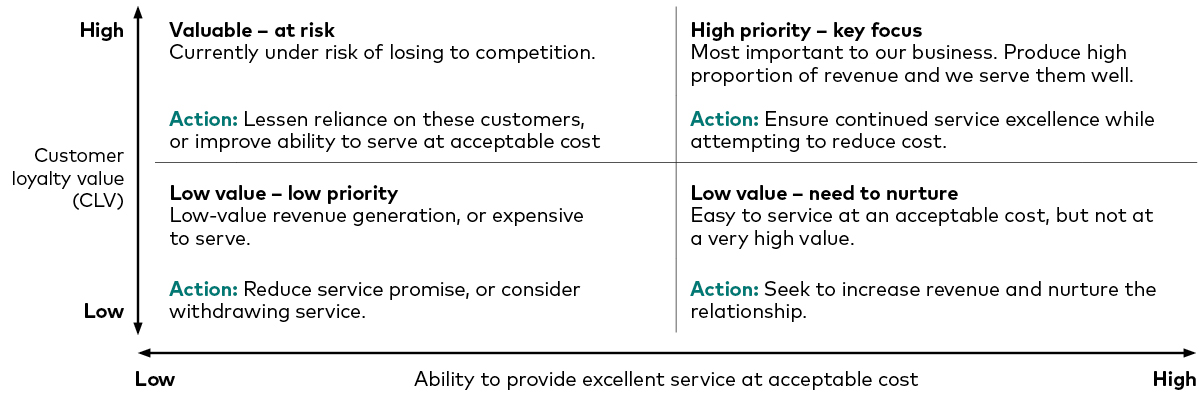
With this in mind, segmenting by customer loyalty value could provide the most important insights into the value of your client base, so this is the area that we will consider in more detail.
Segmenting by customer loyalty value, a step-by-step guide
Segmenting by customer loyalty value (or CLV) will allow your firm to understand how value accrues (or even erodes) from certain clients or client types. By focusing on client revenue, you can use this metric to influence critical business decisions about which segment to focus on.
This approach not only allows an understanding of the value of certain clients but more importantly the attributes of that value – for better or for worse.
There are four steps to undertaking the segmentation process, and we will go through them in more detail in this article. They are:
- Gathering data
- Understanding segments
- Categorising findings
- Determining focus+
Step one: gather data
You will need to collate the relevant data from your client records showing the advice and service delivered. Having this information available in a digital format will of course make this easier. Read our article Managing an effective client database for more information about updating the system you use to maintain your client records if you can't access this information easily on your current system.
The chart below details the sort of information that you will need to collate.
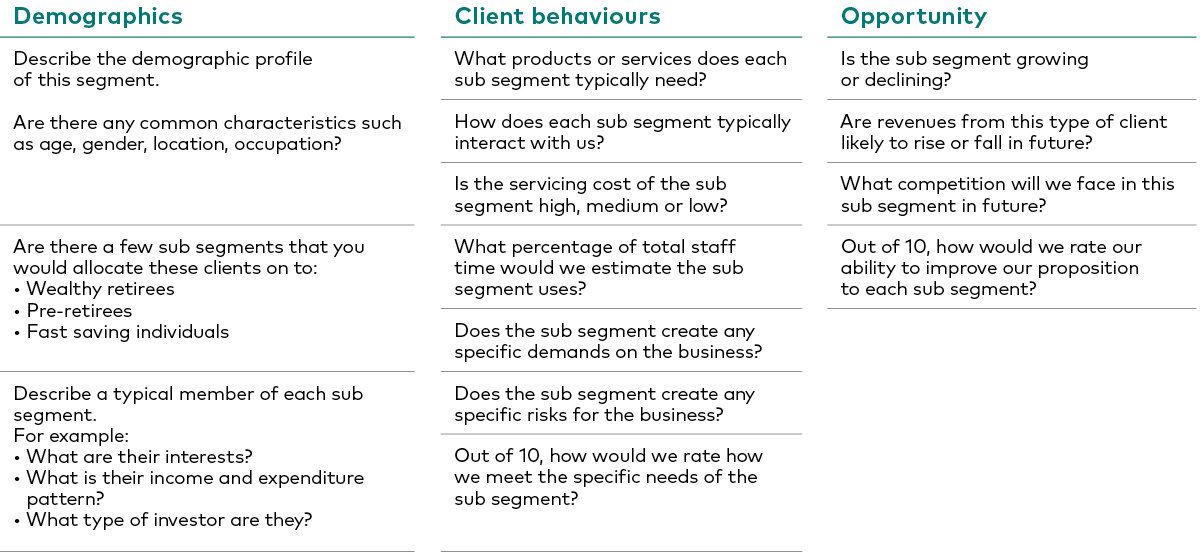
As our focus at this time is client value; the key data you will need for each client is the revenue they produce for the firm. For example, how much does each client pay in ongoing fees, or what ongoing commission or asset-based revenues does each client generate? How loyal is each client?
When this data has been collated, start to tabulate it into quartile or decile rankings, adding it to a table like the one below:
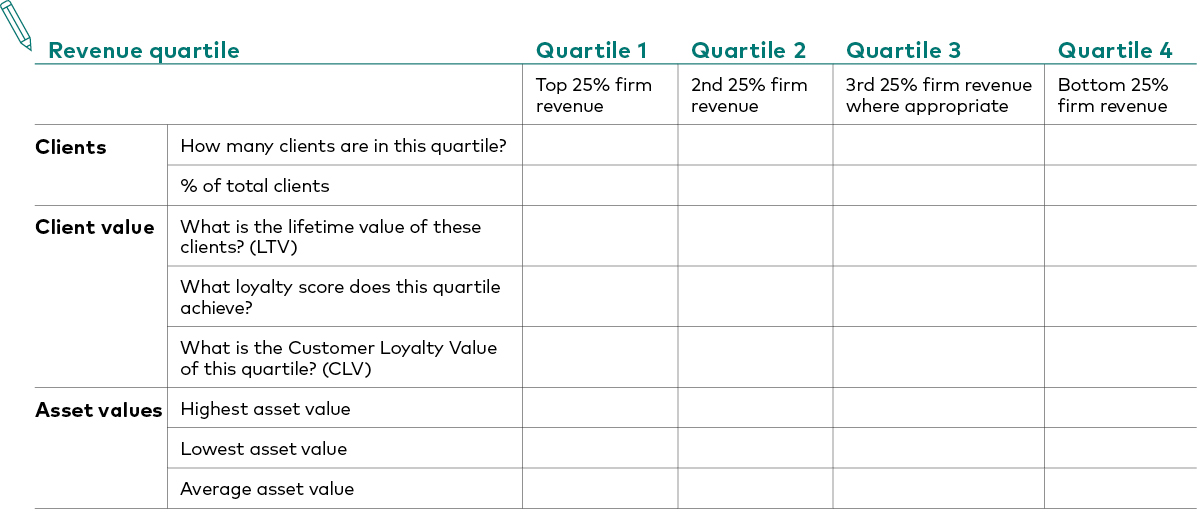
This analysis will show a high-level split of the revenue being earned by the firm and the proportional source of that revenue, together with the CLV for each segment. It is often the case that the smallest proportion of clients produce the largest proportion of revenue for the firm (this is known as the 80/20 rule). Likewise, you may also see a significant number of clients produce a similar or lesser proportion of revenue.
It is good practice to avoid depending on too few clients for revenue but at the same time find more efficient ways to service clients who provide little revenue and little value to your firm. At its extreme, this could mean turning unprofitable clients away but, more often than not, it is about finding a more efficient way to service them. Potentially substituting face to face contact with digital, or bespoke portfolios with an off the shelf solution for example . Don’t forget, a client may not be valuable today, but could be in the future.
Step two: understand the segments