Revisiting euro area equities: A differentiated exposure for modern portfolios
Euro area equities offer a structurally coherent exposure that can play a different role in portfolios to broad Europe equity benchmarks.

Euro area equities offer a structurally coherent exposure that can play a different role in portfolios to broad Europe equity benchmarks.
Europe equities are often treated as a single, interchangeable allocation within global portfolios. In practice, however, there is a meaningful distinction between Europe as a geographic region and the euro area as an economic system. This distinction is central to the investment case for a dedicated euro area equity exposure – such as that available through our new ETF, the Vanguard FTSE Eurozone UCITS ETF.
At its core, the euro area represents a specific combination of shared monetary policy, increasingly coordinated fiscal frameworks and a high degree of economic integration. For equity investors, this coherence matters. Euro area companies operate within a single currency regime under the European Central Bank, which directly influences financing conditions, earnings translation and valuation dispersion.
Many “core Europe” equity ETFs track broader benchmarks such as MSCI Europe or STOXX Europe 600. These indices include major non-euro area markets – notably the UK, Switzerland, Sweden and Denmark – each with its own currency, central bank and policy dynamics. This can meaningfully shift both country weights and sector composition, often in ways that are not immediately obvious to investors.
For example, benchmarks including UK and Switzerland equities tend to increase exposure to global financials, pharmaceuticals and exporters with substantial non-European revenue streams. By contrast, euro area-only indices typically have higher weightings to more domestically anchored industrials, consumer cyclicals and banks whose earnings are more directly tied to euro area activity. This can result in a differentiated factor and earnings profile.
This divergence becomes especially relevant when Europe equities are used as building blocks rather than standalone allocations. A euro area ETF can complement global developed market exposure without inadvertently increasing exposure to UK or Swiss equities already present elsewhere in the portfolio. This avoids unintended concentration and may improve regional balance.
Euro area focus shifts the sector weightings
FTSE Eurozone Index vs. MSCI EMU Index by weights
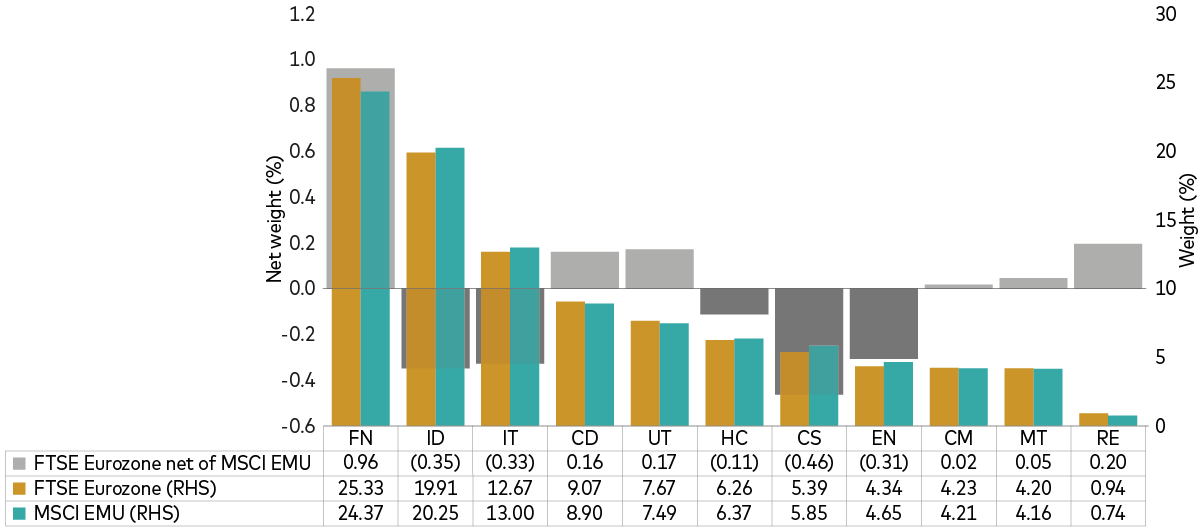
Source: FactSet, data as at 31 March 2026. Note: Data derived from constituents of FTSE Eurozone Index and the MSCI EMU Index. FN = financials, ID = industrials, IT = information technology, CD = consumer discretionary, UT = utilities, HC = healthcare, CS = consumer staples, EN = energy, CM = communication services, MT = materials and RE = real estate. For illustrative purposes only. Index comparisons are provided for informational purposes and do not constitute a recommendation.
One of the more technical – but portfolio relevant – features of the FTSE Eurozone Index is its inclusion of Greece. Greece is a full euro area member yet is excluded from many Europe equity benchmarks due to classification or liquidity criteria.
The FTSE Eurozone Index includes Greece equities, resulting in a small but deliberate allocation. While Greece represents a modest weight, its inclusion reflects an index approach focused on economic definition and completeness, rather than exclusion based on classification criteria. If an investor is seeking euro area equity risk, excluding a euro area country introduces an artificial omission. Over time, such details can matter, particularly should smaller markets experience structural change, capital market deepening or cyclical recoveries.
This is not an argument about return enhancement from Greece specifically. Rather, it reflects an index philosophy that prioritises completeness and economic definition over legacy exclusions – an approach that resonates with disciplined portfolio construction.
Country allocations make a difference
FTSE Eurozone Index vs. MSCI EMU Index by stock count
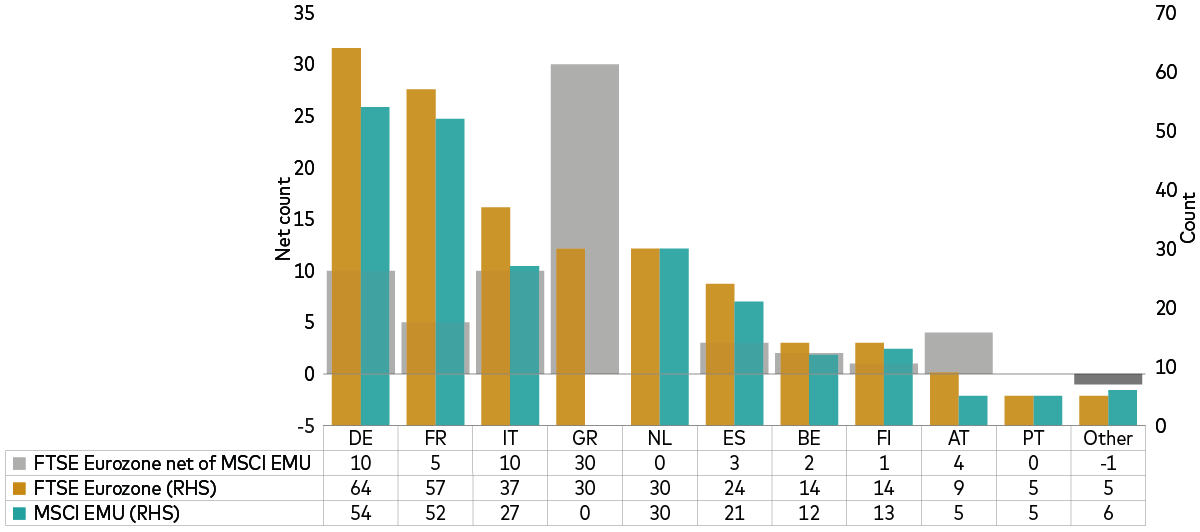
Source: FactSet, data as at 31 March 2026. Note: Data derived from constituents of the FTSE Eurozone Index and the MSCI EMU Index. DE = Germany, FR = France, IT = Italy, GR = Greece, NL = Netherlands, ES = Spain, BE = Belgium, FI = Finland, AT = Austria and PT = Portugal.
For portfolio constructors, the question is not whether to allocate to Europe, but how. Several areas should be considered as part of index and, consequently, ETF selection:
Each of these choices can influence how the allocation behaves across cycles. Euro area exposure could be well suited to investors who think in terms of regional sleeves, risk factor decomposition or macro-driven portfolio design.
The Vanguard FTSE Eurozone UCITS ETF is best understood not as a narrower version of a Europe equity exposure, but as a more precise one. By aligning equity exposure with the economic and monetary reality of the euro area – and by paying close attention to index construction details – it offers portfolio constructors a cleaner, more intentional building block for long‑term allocation decisions.

Discover tools, guides and multimedia resources. Built for (and with) financial advisers.

Investment risk information
The value of investments, and the income from them, may fall or rise and investors may get back less than they invested.
Past performance is not a reliable indicator of future results. The performance data does not take account of the commissions and costs incurred in the issue and redemption of shares.
Performance figures shown may be calculated in a currency that differs from the currency of the share class that you are invested in. As a result, returns may decrease or increase due to currency fluctuations.
ETF shares can be bought or sold only through a broker. Investing in ETFs entails stockbroker commission and a bid-offer spread which should be considered fully before investing.
The Funds may use derivatives in order to reduce risk or cost and/or generate extra income or growth. The use of derivatives could increase or reduce exposure to underlying assets and result in greater fluctuations of the Fund's net asset value. A derivative is a financial contract whose value is based on the value of a financial asset (such as a share, bond, or currency) or a market index.
Some funds invest in securities which are denominated in different currencies. Movements in currency exchange rates can affect the return of investments.
For further information on risks please see the “Risk Factors” section of the prospectus on our website.
Important information
This is a marketing communication.
For professional investors only (as defined under the MiFID II Directive) investing for their own account (including management companies (fund of funds) and professional clients investing on behalf of their discretionary clients). In Switzerland for professional investors only. Not to be distributed to the public.
The information contained herein is not to be regarded as an offer to buy or sell or the solicitation of any offer to buy or sell securities in any jurisdiction where such an offer or solicitation is against the law, or to anyone to whom it is unlawful to make such an offer or solicitation, or if the person making the offer or solicitation is not qualified to do so. The information is general in nature and does not constitute legal, tax, or investment advice. Potential investors are urged to consult their professional advisers on the implications of making an investment in, holding or disposing of shares and /or units of, and the receipt of distribution from any investment.
For Swiss professional investors: Potential investors will not benefit from the protection of the FinSA on assessing appropriateness and suitability.
Vanguard Funds plc has been authorised by the Central Bank of Ireland as a UCITS and has been registered for public distribution in certain EEA countries and the UK. Prospective investors are referred to the Funds' prospectus for further information. Prospective investors are also urged to consult their own professional advisers on the implications of making an investment in, and holding or disposing shares of the Funds and the receipt of distributions with respect to such shares under the law of the countries in which they are liable to taxation.
The Manager of Vanguard Funds plc is Vanguard Group (Ireland) Limited. Vanguard Asset Management, Limited is a distributor for Vanguard Funds plc.
For Swiss professional investors: The Manager of Vanguard Funds plc is Vanguard Group (Ireland) Limited. Vanguard Investments Switzerland GmbH is a financial services provider, providing services in the form of purchase and sales according to Art. 3 (c)(1) FinSA . Vanguard Investments Switzerland GmbH will not perform any appropriateness or suitability assessment. Furthermore, Vanguard Investments Switzerland GmbH does not provide any services in the form of advice. Vanguard Funds plc has been authorised by the Central Bank of Ireland as a UCITS. Prospective investors are referred to the Funds' prospectus for further information. Prospective investors are also urged to consult their own professional advisors on the implications of making an investment in, and holding or disposing shares of the Funds and the receipt of distributions with respect to such shares under the law of the countries in which they are liable to taxation.
For Swiss professional investors: Vanguard Funds plc has been approved for offer in Switzerland by the Swiss Financial Market Supervisory Authority. The information provided herein does not constitute an offer of Vanguard Funds plc in Switzerland pursuant to FinSA and its implementing ordinance. This is solely an advertisement pursuant to FinSA and its implementing ordinance for Vanguard Funds plc. The Representative and the Paying Agent in Switzerland is BNP Paribas Securities Services, Paris, succursale de Zurich, Selnaustrasse 16, 8002 Zurich. Copies of the Articles of Incorporation, KID, Prospectus, Declaration of Trust, By-Laws, Annual Report and Semiannual Report for these funds can be obtained free of charge from the Swiss Representative or from Vanguard Investments Switzerland GmbH via our website.
The Manager of the Ireland domiciled funds may determine to terminate any arrangements made for marketing the shares in one or more jurisdictions in accordance with the UCITS Directive, as may be amended from time-to-time.
The Indicative Net Asset Value (“iNAV”) for Vanguard’s ETFs is published on Bloomberg or Reuters. Refer to the Portfolio Holdings Policy.
For investors in Ireland domiciled funds, a summary of investor rights can be obtained via our website and is available in English, German, French, Spanish, Dutch and Italian.
London Stock Exchange Group companies include FTSE International Limited ("FTSE"), Frank Russell Company ("Russell"), MTS Next Limited ("MTS"), and FTSE TMX Global Debt Capital Markets Inc. ("FTSE TMX"). All rights reserved. "FTSE®", "Russell®", "MTS®", "FTSE TMX®" and "FTSE Russell" and other service marks and trademarks related to the FTSE or Russell indexes are trademarks of the London Stock Exchange Group companies and are used by FTSE, MTS, FTSE TMX and Russell under licence. All information is provided for information purposes only. No responsibility or liability can be accepted by the London Stock Exchange Group companies nor its licensors for any errors or for any loss from use of this publication. Neither the London Stock Exchange Group companies nor any of its licensors make any claim, prediction, warranty or representation whatsoever, expressly or impliedly, either as to the results to be obtained from the use of the FTSE or Russell indexes or the fitness or suitability of the indexes for any particular purpose to which they might be put.
For Dutch investors only: The fund(s) referred to herein are listed in the AFM register as defined in section 1:107 Dutch Financial Supervision Act (Wet op het financieel toezicht).For details of the Risk indicator for each fund listed, please see the fact sheet(s) which are available from Vanguard via our website.
Issued in EEA by Vanguard Group (Ireland) Limited which is regulated in Ireland by the Central Bank of Ireland.
Issued in Switzerland by Vanguard Investments Switzerland GmbH.
Issued by Vanguard Asset Management, Limited which is authorised and regulated in the UK by the Financial Conduct Authority.
© 2026 Vanguard Group (Ireland) Limited. All rights reserved.
© 2026 Vanguard Investments Switzerland GmbH. All rights reserved.
© 2026 Vanguard Asset Management, Limited. All rights reserved.