Key points
- Middle East tensions are shifting the balance of risks towards higher inflation and weaker economic growth.
- Macro dispersion is likely to persist as strength in the US, for example, contrasts with softer conditions in parts of Europe and the UK, partly due to energy and geopolitical pressures.
- Policy responses will diverge, as central banks balance risks to higher inflation with downside risks to growth.
United States
Investment anchors a constructive growth outlook
The US economic outlook remains constructive, with growth expected to be anchored by strong business investment and healthy consumption. We expect real GDP to grow by around the mid‑2% range, driven primarily by robust AI‑related capital expenditures and resilient private domestic demand.
We view the labour market as stable, despite weakness reflected in the 6 March US labour report, with concentrated health care job creation being a structural feature and unemployment expected to remain broadly steady over the year. Inflation continues to decelerate. We project that core inflation will ease towards roughly 2.6% by year‑end 2026, supported by continued housing disinflation and improving productivity trends. We continue to pay attention to the oil market and events in the Middle East for their potential to push inflation higher or disrupt financial conditions.
Against this backdrop, we assess monetary policy to be near neutral, or the rate where it would neither stimulate nor restrict the economy. With growth remaining firm and inflation easing modestly, we expect the US Federal Reserve to proceed cautiously, delivering a single rate cut in 2026.
United States economic forecasts
Notes: GDP growth is defined as the fourth-quarter-over-fourth-quarter change in real (inflation-adjusted) GDP in the forecast year compared with the previous year. Unemployment rate is as of December 2026. Core inflation is the year-over-year percentage change in the Personal Consumption Expenditures price index, excluding volatile food and energy prices, as of December 2026. Monetary policy is the rounded midpoint of the Federal Reserve’s target range for the federal funds rate at year-end.
Sources: Vanguard.
United Kingdom
Middle East tensions pose a risk to Bank of England outlook
Conflict in the Middle East complicates our outlook, adding risk that the Bank of England may delay a rate cut. Oil prices have spiked since the start of the conflict. We estimate that a sustained 10% rise in energy prices would add 0.1 to 0.2 percentage points to headline inflation and trim 0.1 percentage points from GDP.
We expect inflation to fall in 2026 as the government measures lower energy prices, economic slack builds and base effects from last year’s comparisons fade. We continue to anticipate that headline inflation will drift down to 2.2% by year-end 2026 and core inflation to 2.6%, with risks currently skewed to the upside. Year-over-year headline inflation was 3% in January, while year-over-year core inflation (which excludes volatile food, energy, alcohol and tobacco prices) was 3.1%.
We expect real income growth to moderate further this year amid a weak labour market. Meanwhile, fiscal policy will be modestly supportive of activity as day-to-day departmental spending ramps up. We don’t expect a strong AI-driven impulse to investment, unlike in the United States. Our 2026 GDP forecast for the UK is 1%.
United Kingdom economic forecasts
Notes: GDP growth is defined as the annual change in real (inflation-adjusted) GDP in the forecast year compared with the previous year. Unemployment rate is as of December 2026. Core inflation is the year-over-year change in the Consumer Prices Index, excluding volatile food, energy, alcohol and tobacco prices, as of December 2026. Monetary policy is the Bank of England’s bank rate at year-end.
Sources: Vanguard.
Euro area
Middle East conflict raises inflation risks
Conflict in the Middle East and the potential for an extended spike in energy prices pose a risk to our outlooks. We estimate that a persistent 10% rise in energy prices would add 0.1 to 0.2 percentage points to headline inflation and trim 0.1 to 0.2 percentage points from GDP. Given these developments, we have removed our downside bias to the balance of risks around our inflation and policy rate outlooks.
German fiscal spending has picked up in recent months, which is starting to show up in both the hard and soft data. We continue to forecast that German fiscal policy will add 0.5 percentage points to German GDP and 0.2 percentage points to euro area GDP in 2026. On the other hand, higher US tariffs will continue to drag on growth.
Meanwhile, Europe continues to lag well behind in the first phase of the AI cycle (innovation and investment). EU tech‑sector plans for capital expenditure in a range of $250 billion to $300 billion over the next two years remain far smaller than US tech spending plans which amount to more than $2 trillion. Our view is that in the second phase of the cycle (adoption), AI adoption in Europe will be slightly slower and lower than in the US. Europe’s economy differs from the US in a few important ways: Europe has a larger share of smaller companies, more restrictive regulation and a slightly lower share of services-oriented activities, which are most exposed to AI automation.
Euro area economic forecasts
Notes: GDP growth is defined as the annual change in real (inflation-adjusted) GDP in the forecast year compared with the previous year. Unemployment rate is as of December 2026. Core inflation is the year-over-year change in the Harmonised Indexes of Consumer Prices, excluding volatile energy, food, alcohol and tobacco prices, as of December 2026. Monetary policy is the European Central Bank’s deposit facility rate at year-end.
Sources: Vanguard.
Japan
Bank of Japan poised for gradual rate increases
Japan’s economy continues to move steadily toward normalisation. We expect private consumption to remain resilient, supported by robust wage growth, the positive effects of income tax cuts and the potential for fiscal stimulus. However, higher oil prices stemming from the conflict in the Middle East represent a significant inflationary risk. Most of Japan’s oil comes from the Middle East, although Japan’s relatively deep oil reserves would act as a buffer.
Inflation continues to edge higher amid firm wage growth. We expect labour‑intensive services prices to rise, contributing to a gradual pickup in inflation. In the short term, however, easing food price gains and strengthened energy price controls could temper inflation.
We expect the Bank of Japan (BoJ) to remain committed to a gradual normalisation of monetary policy. Notably, the BoJ has emphasised that exchange rate movements now have a greater influence on domestic prices, reflecting a change in corporate behaviour as firms have raised wages and prices in response to external cost pressures. We expect two quarter-point rate hikes, which would raise the policy rate to 1.25%, by the end of 2026.
Japan economic forecasts
Notes: GDP growth is defined as the annual change in real (inflation-adjusted) GDP in the forecast year compared with the previous year. Unemployment rate is as of December 2026. Core inflation is the year-over-year change in the Consumer Price Index, excluding volatile fresh food prices, as of December 2026. Monetary policy is the Bank of Japan’s year-end target for the overnight rate.
Sources: Vanguard.
China
Tech tailwinds confront housing headwinds
After reaching 5% in 2025, GDP growth is likely to moderate to around 4.5% in 2026 as the contribution from net exports diminishes amid tariff effects and continued trade policy uncertainty. Beyond cyclical factors, demographic headwinds are intensifying. China’s population has decreased for four straight years, a decline that policy support has so far failed to stem.
Policymakers are increasingly concerned about China’s sharp slowdown in domestic demand. In response, the government has frontloaded bond issuance, while monetary authorities have introduced targeted rate cuts, expanded liquidity quotas for priority sectors and lowered downpayment requirements for commercial mortgages. The potential inflationary effects of higher oil prices due to the conflict in the Middle East would be felt less in China than in many other countries.
The People’s Bank of China has kept policy rates broadly unchanged, reiterating that any further easing will be selective. Credit growth is slowing, reflecting payback from earlier fiscal frontloading and softer household demand. By year-end, we expect only a modest policy rate cut of 20 basis points, which would bring the policy rate to 1.2%. A basis point is one-hundredth of a percentage point.
China economic forecasts
Notes: GDP growth is defined as the annual change in real (inflation-adjusted) GDP in the forecast year compared with the previous year. Unemployment rate is as of December 2026. Core inflation is the year-over-year change in the Consumer Price Index, excluding volatile food and energy prices, as of December 2026. Monetary policy is the People’s Bank of China’s seven-day reverse repo rate at year-end.
Sources: Vanguard.
Asset-class return outlook
Vanguard has updated its 10-year annualised outlooks for broad asset class returns through the most recent running of the Vanguard Capital Markets Model® (VCMM), based on data as at 31 December 2025.
Our 10-year annualised nominal return projections1, expressed for local investors in local currencies, are as follows:
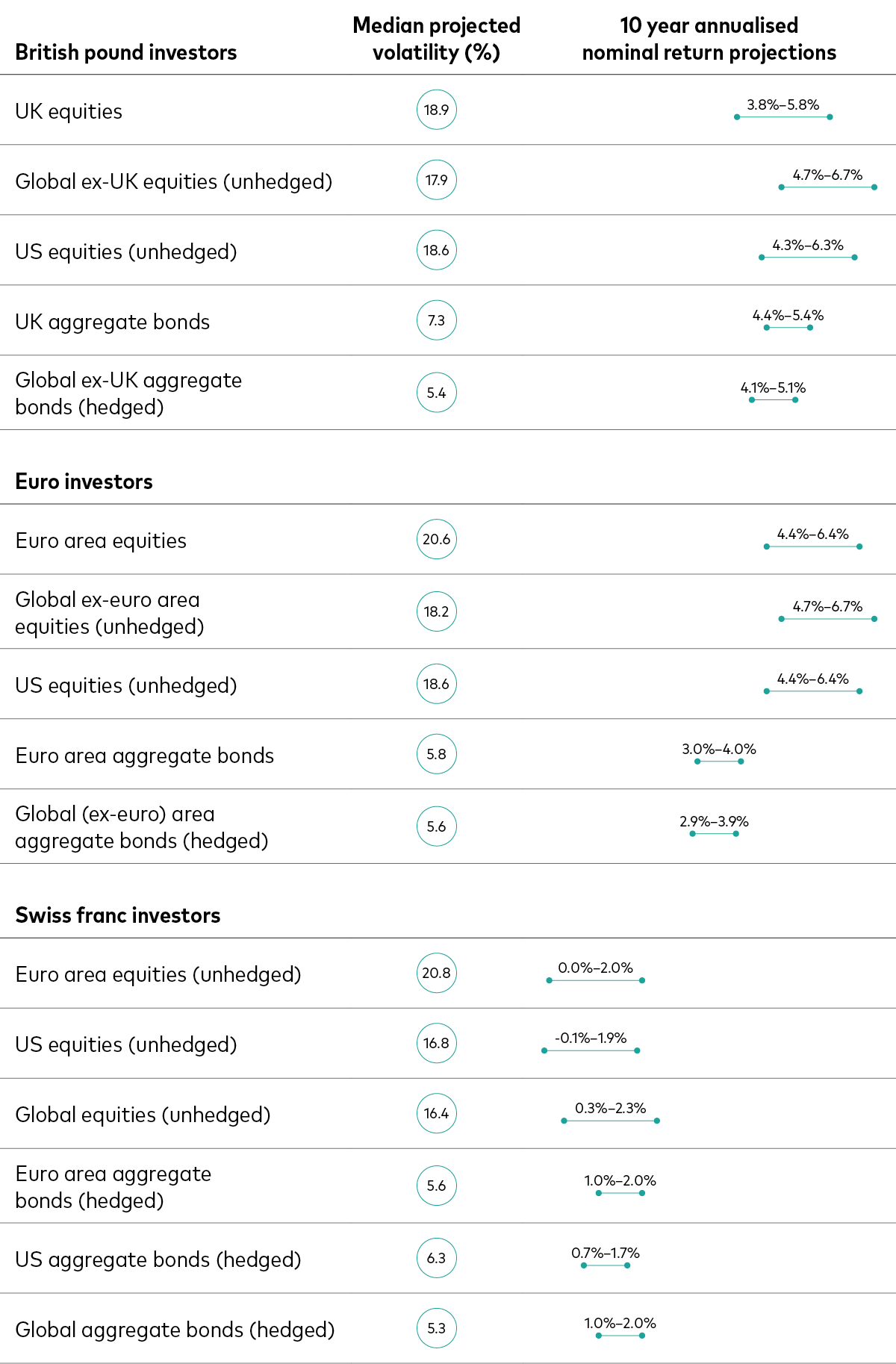
1 The figures are based on a 2-point range around the 50th percentile of the distribution of return outcomes for equities and a 1-point range around the 50th percentile for fixed income.
On demand
Vanguard 2026 economic and market outlook
Webinar
Our economists share their views on what lies ahead for global markets in 2026.
Jumana Saleheen and Shaan Raithatha
Increase your investment expertise and earn CPD
Discover tools, guides and multimedia resources covering topics from investment principles to portfolio construction.

IMPORTANT: The projections or other information generated by the Vanguard Capital Markets Model® regarding the likelihood of various investment outcomes are hypothetical in nature, do not reflect actual investment results, and are not guarantees of future results. VCMM results will vary with each use and over time. The VCMM projections are based on a statistical analysis of historical data. Future returns may behave differently from the historical patterns captured in the VCMM. More important, the VCMM may be underestimating extreme negative scenarios unobserved in the historical period on which the model estimation is based.
The Vanguard Capital Markets Model® is a proprietary financial simulation tool developed and maintained by Vanguard’s primary investment research and advice teams. The model forecasts distributions of future returns for a wide array of broad asset classes. Those asset classes include US and international equity markets, several maturities of the U.S. Treasury and corporate fixed income markets, international fixed income markets, US money markets, commodities, and certain alternative investment strategies. The theoretical and empirical foundation for the Vanguard Capital Markets Model is that the returns of various asset classes reflect the compensation investors require for bearing different types of systematic risk (beta). At the core of the model are estimates of the dynamic statistical relationship between risk factors and asset returns, obtained from statistical analysis based on available monthly financial and economic data from as early as 1960. Using a system of estimated equations, the model then applies a Monte Carlo simulation method to project the estimated interrelationships among risk factors and asset classes as well as uncertainty and randomness over time. The model generates a large set of simulated outcomes for each asset class over several time horizons. Forecasts are obtained by computing measures of central tendency in these simulations. Results produced by the tool will vary with each use and over time.
The primary value of the VCMM is in its application to analysing potential client portfolios. VCMM asset-class forecasts—comprising distributions of expected returns, volatilities, and correlations—are key to the evaluation of potential downside risks, various risk–return trade-offs, and the diversification benefits of various asset classes. Although central tendencies are generated in any return distribution, Vanguard stresses that focusing on the full range of potential outcomes for the assets considered, such as the data presented in this paper, is the most effective way to use VCMM output.
The VCMM seeks to represent the uncertainty in the forecast by generating a wide range of potential outcomes. It is important to recognise that the VCMM does not impose “normality” on the return distributions, but rather is influenced by the so-called fat tails and skewness in the empirical distribution of modelled asset-class returns. Within the range of outcomes, individual experiences can be quite different, underscoring the varied nature of potential future paths. Indeed, this is a key reason why we approach asset-return outlooks in a distributional framework.
Investment risk information
The value of investments, and the income from them, may fall or rise and investors may get back less than they invested.
All forecasts should be regarded as hypothetical in nature and do not reflect or guarantee future results.
Important information
For professional investors only (as defined under the MiFID II Directive) investing for their own account (including management companies (fund of funds) and professional clients investing on behalf of their discretionary clients). In Switzerland for professional investors only. Not to be distributed to the public.
The information contained herein is not to be regarded as an offer to buy or sell or the solicitation of any offer to buy or sell securities in any jurisdiction where such an offer or solicitation is against the law, or to anyone to whom it is unlawful to make such an offer or solicitation, or if the person making the offer or solicitation is not qualified to do so. The information does not constitute legal, tax, or investment advice. You must not, therefore, rely on it when making any investment decisions.
The information contained herein is for educational purposes only and is not a recommendation or solicitation to buy or sell investments.
Issued in EEA by Vanguard Group (Ireland) Limited which is regulated in Ireland by the Central Bank of Ireland.
Issued in Switzerland by Vanguard Investments Switzerland GmbH.
Issued by Vanguard Asset Management, Limited which is authorised and regulated in the UK by the Financial Conduct Authority.
© 2026 Vanguard Group (Ireland) Limited. All rights reserved.
© 2026 Vanguard Investments Switzerland GmbH. All rights reserved.
© 2026 Vanguard Asset Management, Limited. All rights reserved.